Friday, January 10, 2014

Breaking News: Obituary of Amiri Baraka

Amiri Baraka
              Amiri Baraka died yesterday; Janiary 9, 2014. He was an African-American black person and a writer of poetry, fiction, nonfiction, drama, essays and music criticism then he won some awards and honors of poetry, drama and literatures. Across his generation, he was the most published black writer. The literary style of his writing shows some negation of American social discrimination for blacks. Though he is famous in America, not known to Japanese.


              In October 7 1934, Baraka was born inNewark, New Jersy and at this time, he was named LeRoi Jones. After leaving his university, in 1954, he joined the US Air Force as a gunner. Later, he left there and began to work on warehouse. Some years later, in 1961, he published his first book of poet, Preface to a Twenty Volume Suicide Note. When Barack Obama stood for the Presidential election, in 2008, Baraka was supporting him and blaming for those who criticize Obama, anti-black workers. Then it was said that blaming is too violent. In2002, scholar Molefi Kate Asante included Amiri Baraka on his list of 100 Greatest African Americans.


              On January 9, 2014 at Beth Israel Medical Center in Newark, New Jersey, Amiri Baraka passed away but the reason is not reported.


references
http://www.biography.com/people/amiri-baraka-9198235

Thursday, January 9, 2014

#8_Difficulties and Problems

              The enemies of gardening, not only individuals also pubric, are harmful insects, animals and pests. Sometimes they eat away many parts of plants; beautiful foliages and flowers. Especially, vegetable gardens get more dameges from these bad elements. But almost all of them are not scary if you take appropriate care for them.

Spittlebug
              Not all of insects in the garden are not harmful; some are rather helpful than harmful for gardens. For example, ladybugs are eating aphid, one of major insect pests of gardens. There are many other pests in the garden; scale, leaf miners, spittlebugs and so on. Most of them are difficult to recognize that they are bugs at a glance. Scale insects look like knots on stems of plants. Leaf miners make zig zag tracks on leaves. Spittlebugs make clump of form and hide in it. They sip juice from plants and it can make plants weaken. If you find these pests in your garden, remove them away from the garden immediately. Galls are one kind of signs of these diseases. Actually, the gall itself is not an insect but influence of irritation. When insects damage trees, galls are appear mainly on leaves. They usually don’t kill plant but weaken them. For example, early leaves drop is caused by galls.


Black Spot
              Bad things for plants are not only bugs but also diseases. Tomato especially has risks of getting all kind of diseases. As far as you care tomato with proper way, these diseases are rarely deadly. But a lot of diseases exist in the garden. How correctly to distinguish these ills is important though there are too much species of them to write here down. Roses are beautiful and popular flowers. I’ll show some examples of rose diseases here. “Black spot” is one kind of fungus. As its name implies, black spots are appear on leaves. This can drop leaves. “Downy mildew” is very fatal disease. It spreads so rapidly and defoliates rose leaves in days. Black spot likes humid weather. Downy mildew prefers cold and wet climate to humid one.


Downy Mildew


              There is another bad thing for plants, nutrient deficient. If some bad effect like discoloration is seen with plant in spite of not having disease or insects on plant, it may be nutrient deficient. It is caused by some bad condition of roots; soil is not suit for the plant, little nutrition is in the soil or too much or little water is served. So, the solution is easy. To make the best status of soil.


references
Mypedia (encyclopedia)

Tuesday, December 17, 2013

#7_Gardening in Recent Years

One Example of Rooftop Gardening
              Today, urban greening is actively carried out. One of a popular thing is rooftop gardening. It is easy to understand, making a garden on the rooftop of building. More and more roofs of buildings or structures are greened. Then, why do we need plant on structures? Concrete, asphalt or steel doesn’t release the heat well. On the other hand, plants can decrease the temperature with evaporating water. Urban heat island is famous influence of global warming and rooftop greening is said lessen that effect. Moreover, leaves can absorb CO2 or NOx, produced mainly from cars, factories and so on. It is, of course, rooftop gardening has a purpose of beautification. On the other hand, build and maintenance cost is higher than normal garden. In many ways, rooftop greening is great gardening style.


              Gardens in many cultures, it is begun by the rich. So, it is important to have some knowledge of what does it seems or express when you visit classical garden. But many gardens today do not have these vague meanings. Gardens become only a way to represent something. On the other hand, it can be said that gardening becomes more popular than previous days. More and more species of flowers or trees are produced, so choices of decollating one’s garden are expanded. It is good, however, there is problem. Hybrid and new species of plants are usually stronger than original ones. So, these new species can make other originals extinct.


              A guerrilla gardening is an interesting activitie. Guerrilla gardeners plant some flowers or trees on the land that is not permitted to do that; planting without admission of that land’s owner. Today, it is held chiefly in Europe and North America. That ground is usually neglected or rough. At night, guerilla gardeners begin to plant or sow. When it is over, they break up soon. The conditions of species usually used for guerrilla gardening are; it is good for surviving and not introduced species. However, colorful flowers are also good for guerrilla gardening to coloring landscapes. But never forget that it is illegal activity in general view and excess guerrilla gardening can break landscapes. It is remarkable that plant grows on polluted land, that plant may get polluted. Then, if a dog eats that leaves, it is dangerous. When you try guerrilla gardening, a lot of tiny care is required. You can visit the official website of guerrilla gardening; guerrilla gardening.org.


An Instance of Guerrilla Gardening


Photos and references

Wednesday, December 11, 2013

Nelson Mandela: Breaking News

     Nelson Mandela, born in Transki, South Africa in 1918, was passed away at 20:50 (GMT +2) December 5, his age at death is 95 years old. His true name is “Nelson Rolihlahla Mandela”, that language is Xhosa, one of the official languages of Republic of South Africa. During his lifetime, he acted as a member of anti-apartheid movement, lawer, commander of the military organization, and President of South Africa. Moreover, the first black President after the age of whites had ruled.
    
     Apartheid was severe racism policy mainly enforced in South Africa. “Apartheid” is Afrikaans word that means “separation” or “isolation”. Almost everything in daily life was separated for blacks and whites. Works, living areas, educations, marriages and many institutions (restaurants, hotels, buses etc.) ware all subject of the law.


African National Congress Flag.svg
Battle Flag of Umkhonto we Sizwe
     He is famous as an anti-apartheid revolutionary. He had been opposing apartheid from his college student days to apartheid had been avolished. After he graduated from university, in August 1952, he founded a low firm. Then, in November 1961, a militant “Umkhonto we Sizwe” (seems "Spear of the Nation") was co-founded by him. But in August 1962, he got arrested and life imprisonment of treason in 1964. Finally, he was released in February 1990. He conferred with the then President, Frederic Willem de Klerk, who was a man who played very important role in the abolition of the apartheid on the law, in December 1989. In 1991, he became the chairman of ANC (African Nation Congress) and made a declaration of apartheid abolition. Later, in 1993, he got Nobel Peace Prize with Klerk. In April 1994, the first election that opened up to all races was held and Mandela became the President. As a president, Mandela removed all laws of apartheid completely. Before that, some of the laws are still remained despite declaration in 1991.

    He was a president by 1999 and retired the political world this year. After retired, there are many struggles against his disease. Actually, he got respiratory disease while he is in prison and he got ill of lung infection in his later years. He hospitalized twice and finally, he breathed his last at his home. During his lifetime, he got married three times.

     Do you know “Nelson Mandela Day”? It is an international day enacted by UN in 2009. The sumarry of it is, in his birthday, July 18, spend 67minutes for someone’s hapiness; the number 67 seems the length of years Mandela had fought for apartheid. While he was died, we can treat others with 67minutes.


references
http://zatsuneta.com/archives/107182.html

pictures

Sunday, December 1, 2013

#6 Gardening in Other Cultures

     Gardening in other cultures is also interesting. Three traditional gardens are introduced below but there are more great garden styles in the world not referred here.

A Chinese Garden
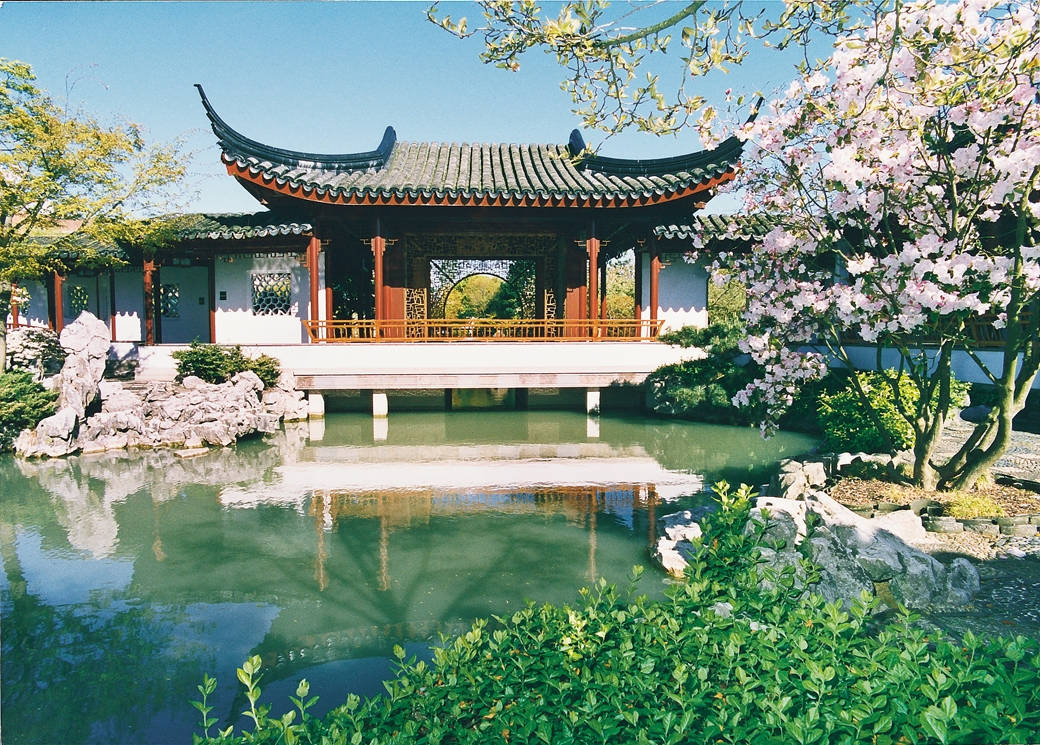
     First, Chinese gardens have long history; more than 3000 years. They look similar to Japanese ones, though history of each gardens are different. A typical Chinese garden today has pounds and halls and pavilion. Visitors walk through winding paths and enjoy change of scenery. In contrast with Japanese ones, there are more stones and buildings than Japanese. Moreover, Chinese gardens have main composition and all of the other elements of garden are rely on it. On the other hand, Japanese one does not have such formation but each part of the garden are independent from each other. As an another difference, Chinese gardens are larger than Japanese ones. Maybe, people don’t live in these countries feel difficult to distinguish Chinese garden from Japanese one.


Tropical Garden Down Under.
A Tropical Garden
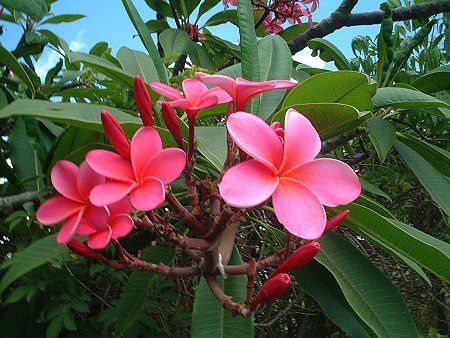
     Second, Tropical gardens are also beautiful. This kind of garden contains many species of characteristic tropical plants. They have large green leaves or bright flower petals. There are some tropical gardens in cold climate areas. Actually, some species of tropical plants can live in colder climate; on the condition that careful consideration of placing plants and flowers to get appropriate sunlight. Even so, tropical plants and flowers are good in warm climate. And more, generally, in tropical garden, there are more foliage plants than flower plants. Frangipani is one kind of a popular tropical plant with cute flower, especially seen in Hawaii. Hibiscus is also famous tropical flower known with red elegant petals. Ferns or papaya tees are popular plants of trppical garden too.
プルメリア(Plumeria)
Flowers of Frangipani
Eram Garden


     Third, Persian gardens, typified in the Taj Mahal or Eram Garden, place importance on structures. This kind of garden influence many other gardens west from Spain, east to India. Persian garden has so long history back to 4000B.C.E. Original Persian gardens imitate “The Garden of Eden”, that seems four livers and four quadrants represent the world. As these words represents, Persian garden has four rivers and a castle in the center of the garden. In 2011, nine Persian gardens in Iran are registered as the World Heritage Site; they are Pasargad Persian Garden, Chehel Sotoun, Fin Garden, Eram Garden, Shazdeh Garden, Dolatabad Garden, Abbasabad Garden, Akbarieh Garden and Pahlevanpour Garden. By the way, Taj Mahal is in India but called the largest ‘Persian garden’. Buildings are Indian style but composition of garden is the very Persian garden.

タージ・マハル
Taj Mahal

A structure of Persian garden


references:
wikioedia

photos from: 

Wednesday, November 20, 2013

#5 Japanese Garden

     Japanese garden is far different from European ones. European gardens take the view of the nature itself frankly or show beauties of symmetrical visions, but Japanese gardens idealize natural landscapes and remake them the best form for Japanese. It sounds abstract and hard to imagine but to see a photo, it is clear. There are obvious unnatural curves everywhere; however, panoramic views of the gardens are not so unnatural. That is what Japanese pursued. Basically, Japanese gardens have a pound (carps are often swimming in it) then to around it, trees, shrubs, moss, stones and water flow are arranged.

Karesausui
In Japanese garden, you may see the ground filled with sands and stones and surface of it looks wavy. It is one style called “karesansui”. Karesansui is the way to represent water flow without waters. Then, there is a reason not to use water itself. At first, yard with white sand in Zen temple was one place for ritual. But gradually, rituals became not placed in there. Instead of this, that yard changed to the place for zen meditation. Karesansui is a view suitable for meditation for zen priest.


Three Great Japanese Gardens are “Kairakuen”, “Kourakuen” and “Kenrokuen”. Kairakuen was opened at Mito, Ibaraki, Japan in 1842. It is said famous place of plum trees. “Kourakuen” is placed at Okayama. It started construction in1687 and completed in1700. By the way, around 1700 B.C., there were still samurai in Japan. “Kenrokuen” is placed in Kanazawa, Ishikawa. At that time, Kanazawa was said very rich city, so Kenrokuen have great landscapes. Don’t forget there are so many other beautiful gardens in Japan.
Kairakuen with plum trees
Kourakuen
Kenrokuen


Shakkei
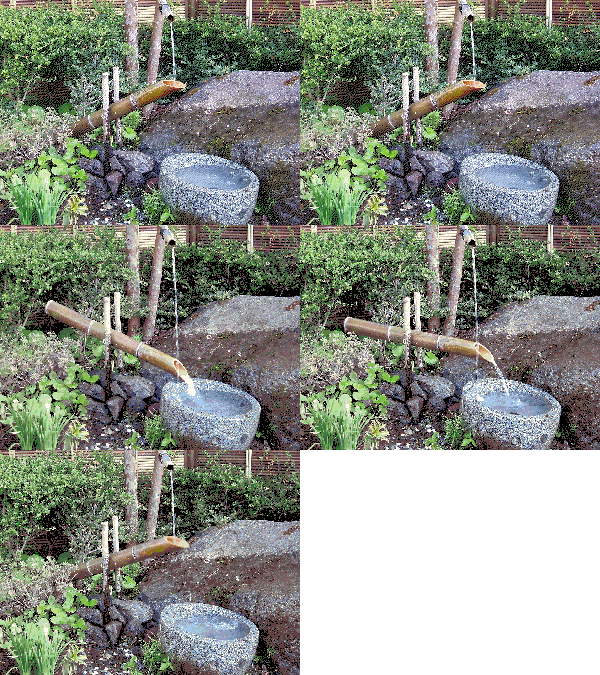
There is some popular equipment of Japanese garden. First, shishiodoshi is very popular facility in Japan. It is for threaten wild harmful animals and prevent them from walking up to the garden with making sound. It works by water power. Second, tourou is a kind of lantern made by stone. Actually, in the garden, tourou acts as decoration rather than light spot. Then, a technique to show the garden better called “shakkei” is great. Shakkei seems “borrow a scene” in English. As its name suggests, shakkei is an art of the garden and landscapes of nature. There is a photo of one example of shakkei. The garden in the front of the picture is real garden and the mountain in the back is not in the garden’s premises. It borrows the mountain’s scenery and makes more extent. 
Shishiodoshi
Tourou
references

http://www.pref.ishikawa.jp/siro-niwa/kenrokuen/index.html

photos from

Tuesday, November 12, 2013

#4 Gardening in Europe

THe Beauty of English Gardens  - English Garden Pictures: The View from the Terrace at Haddon Hall  3
A view of an English garden
     The most popular style of gardens in Europe is, as long as I investigated about it, the English gardens. They appeared in the early 18th century and spread across Europe. Actually, it is said that English gardens took inspiration from some paintings of landscapes, and surprisingly, from classic Chinese gardens. It is the peculiarity of the English gardens that they usually have a lake and recreations of classical temples. Later, it spread throughout Europe.


 There are three great creator of the English landscape garden. William Kent (1685-1748) is at once a painter and interested in architecture, but not a gardener. He made a garden with extremely natural landscape. Next, Lancelot Brown (1716-1783), famous as Capability Brown, has a gift for gardener; he could tell what to remove from a garden, where to put an accent and which to root the plants at once. He is enthusiastic particularly about creating a lake, and then, he plant trees around it. In addition, his garden is said that it is too natural to identify whether it is the natural one or not. Humphrey Repton, the last of the three, was good at painting watercolor. He renovated some gardens and established “The Red Book”; he drew watercolor of the before and after of the gardens he renovated and the book became popular. His gardening style followed Brown’s one.


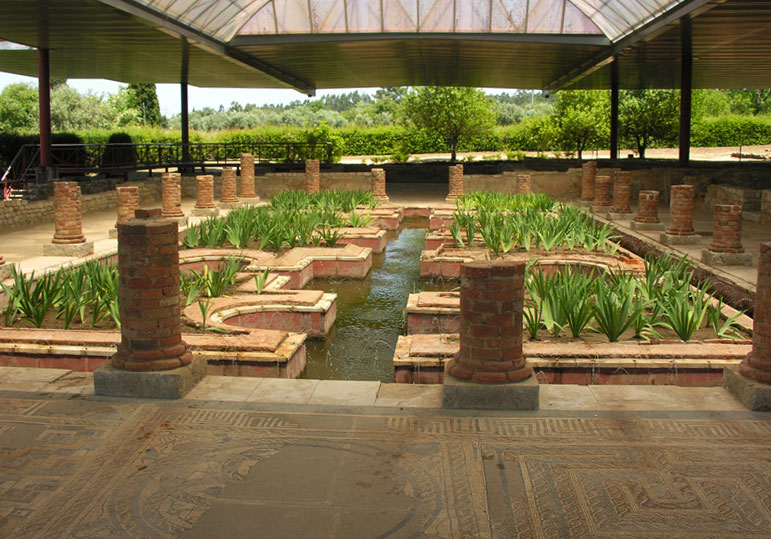
     Roman gardens are influenced by Egyptian, Persian and Greek gardens. The Roman garden is made up by three parts; the terrace, the ambulation, and the gestation. The terrace is used as a drawing room. The ambulation is a space for recreation or conversation. The gestation is avenue and usually it encircles the ambulation. Then, today’s Italian gardens are influenced from Renaissance. There are a lot of sculptures made of stones.

Conimbriga Roman Garden
Conimbriga Roman Garden,
An Italian garden
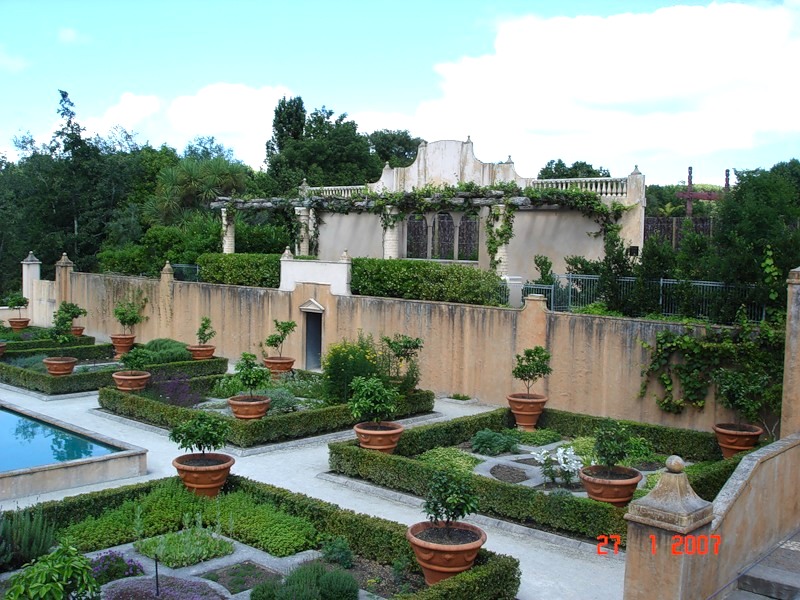
     The beginnings of the French formal gardens are back to the era of the Renaissance. Some Italian landscape architects brought gardening plans into France and it spread throughout the country. They are symmetric gardens. The views of them are like that shrubs and lawns are spread regularly through the large area and it makes passages. In addition, French formal gardens usually have castles. By the way, France is the birthplace of rose gardens.

French garden
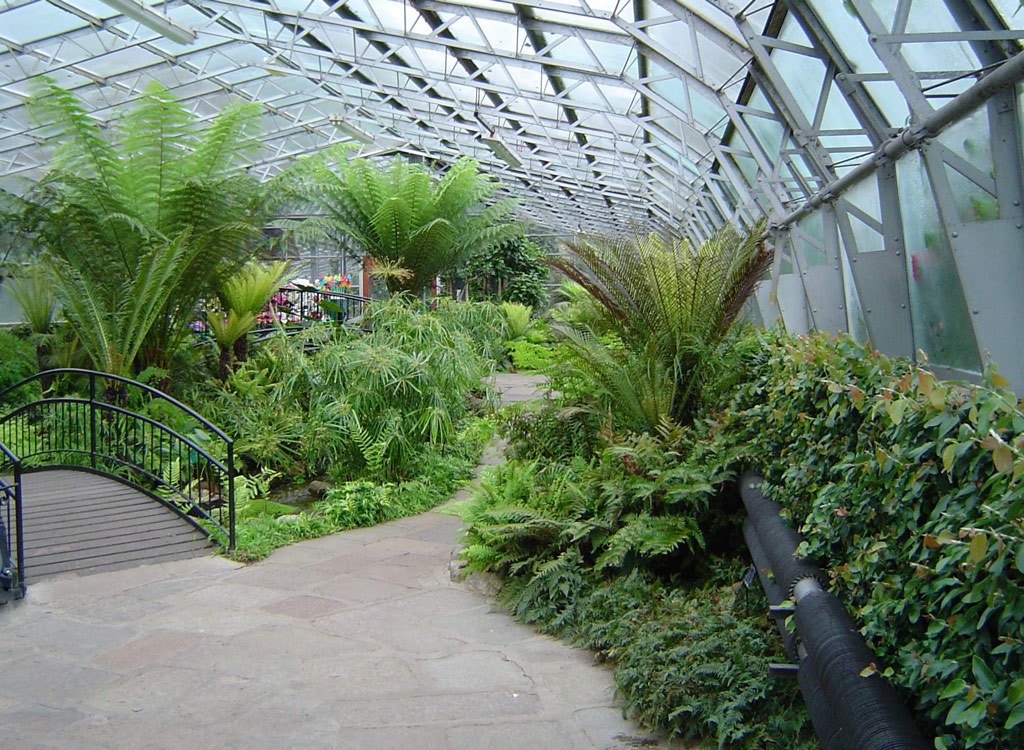
     Another garden birth in Europe is winter garden. Winter garden is the way to glow plants indoors through winter which are not good at cold climate. Many part of the roof is made of glass. The first winter garden was built in London.

Winter grden

references
http://www.pcc-gardendesign.net/lesson-F-history/F-garden-history.htm
Wikipedia (English landscape garden, Gardens of the French Renaissance, French landscape garden, Italian Renaissance garden, Rose garden, Winter garden)


pictures from